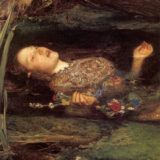

香り高い、美しい花にあふれるイングリッシュ・ローズは多くのバラ愛好家の賛辞を浴びています。よく整ったオレンジ花の“レディ・オブ・シャロット(Lady of Shalott)にちなんだ話をご紹介します。
レディ・オブ・シャロット(Lady of Shalott)
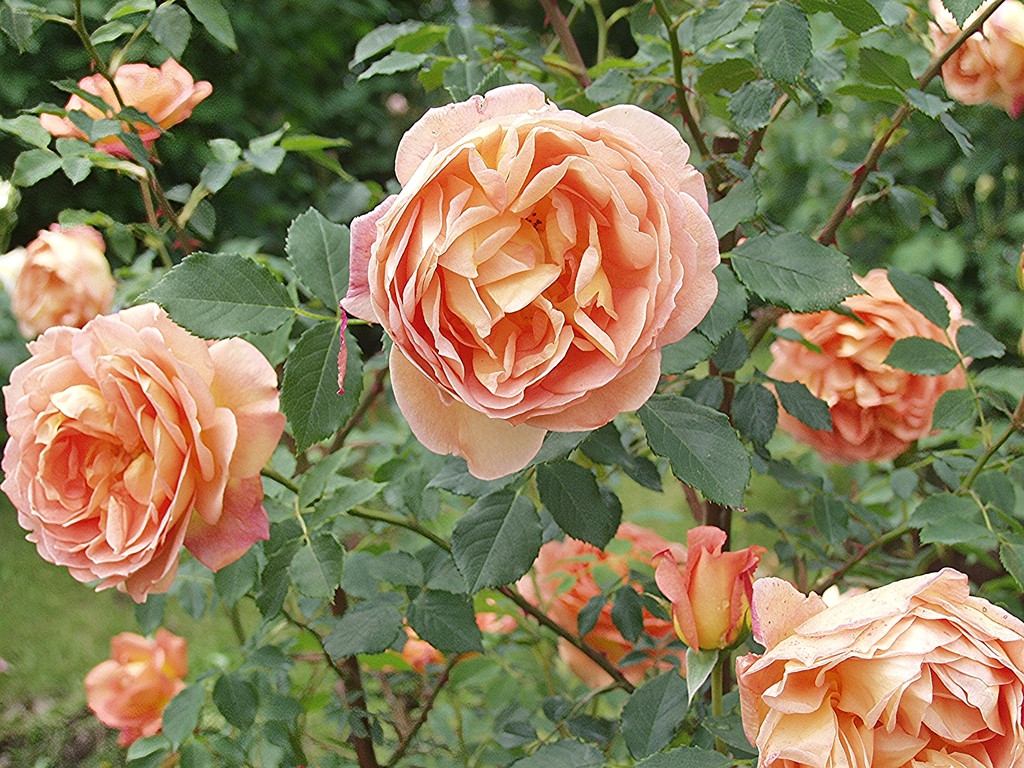
9cmから11cm径、フォーマルで閉じ気味のつぼ型、またはカップ型となる花形。
花色はピンク・オレンジ、全体にイエローが強く出てアンバーに近い色合となることもあります。
軽く、ティー・ローズ系の香りがします。
中型の縁のノコ目が強くでる、深い色合のつや消し葉。細めでトゲの少ない、横張り性の強い枝ぶり、120cmから180cm高さの中型のシュラブとなります。枝がたおやかですので、小さなアーチやトレリスなどに誘引してうつむかげんに開花する花を楽しむのがおすすめです。
育種者、命名の由来など
2009年、ディヴィット・オースチン農場から育種・公表されました。交配親の詳細は公開されていません。
英国ヴィクトリア朝時代の詩人アルフレッド・テニスン(Alfred Tennyson:1809-1892)の生誕200年を記念して命名されました。
テニスンの代表作は水夫の悲劇を描いた物語詩『イノック・アーデン』(1864年)です。浪漫派の詩人として知られています。
テニスンは、イギリス国教会の牧師であったジョージ・クレイトン・テニスンの三男として生まれ、若い時代から兄たちと私的な詩集を編むなどしていました。長じてケンブリッジ大学で学んでいましたが、1831年、父の死去直後、中途退学して故郷リンカーンシャーに戻り、詩作など活動を続けていました。
1833年、『詩集(Poems)』を公刊、そのうちの一偏が『シャロットの妖姫(Lady of Shalott)』でした。
ところが、このロマンティックな詩集は公表当初は酷評をもって迎えられました。表現がおおげさに過ぎると感じられてしてしまったのではないでしょうか。
深く傷ついたテニスンはその後10年間作品を公表しなくなってしまいました。しかしこの『シャロットの妖姫』は時を経るにしたがい再評価されてゆき、物語、音楽、絵画など、多くの芸術作品の題材となりました。
長編詩『シャロットの妖姫(Lady of Shalott)』
こんな物語です。
川の中州にある古城に閉じ込められているシャロット姫は、外の世界を直接見ると死んでしまうという恐ろしい呪いをかけられています。彼女は部屋に鏡を据え、そこに写る外の世界を眺めながら、その情景を織物に編み込むことで無聊をなぐさめていました。ところがある日、シャロットは騎士ランスロットの姿を鏡のなかに見つけます。姫は一瞬にして魅了されてしまいました。
ランスロットの姿を見ようと思わず外の世界を直接見てしまうシャロット姫…おそろしい呪いが現実のものになってしまいます。
鏡は割れ、織物はほどけ、姫にからみついてしまいます。覚悟した姫は小舟に身を横たえ死出の旅へと旅立ちます。やがて小舟は騎士ランスロットがいるアーサー王の居城キャメロットに流れ着きましたが、そのときすでに姫はこと切れていました。
ランスロットは彼女の死を悼み、冥福を神に祈る場面で詩は終わります。
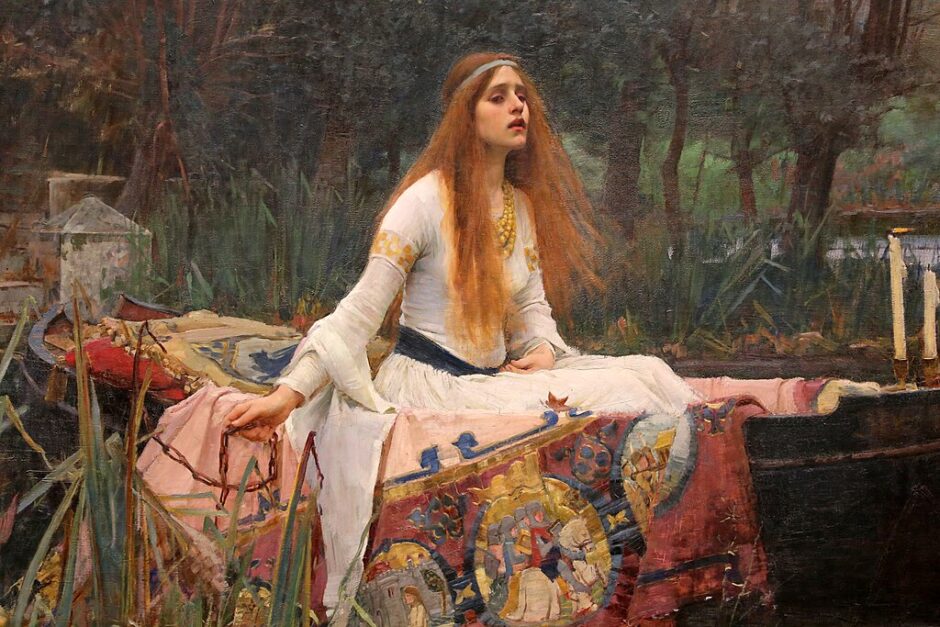
ジョン・W・ウォーターハウスが描く’Lady of Shalott’
英国、ヴィクトリア時代を代表する画家のひとりであるジョン・W・ウォーターハウス(John William Waterhouse:1849-1917)はことにこの題材に強くひきつけられたのでしょう、彼の最高傑作といわれる『湖上のシャロット姫』など、同じ題材で三つの傑作を残しています。
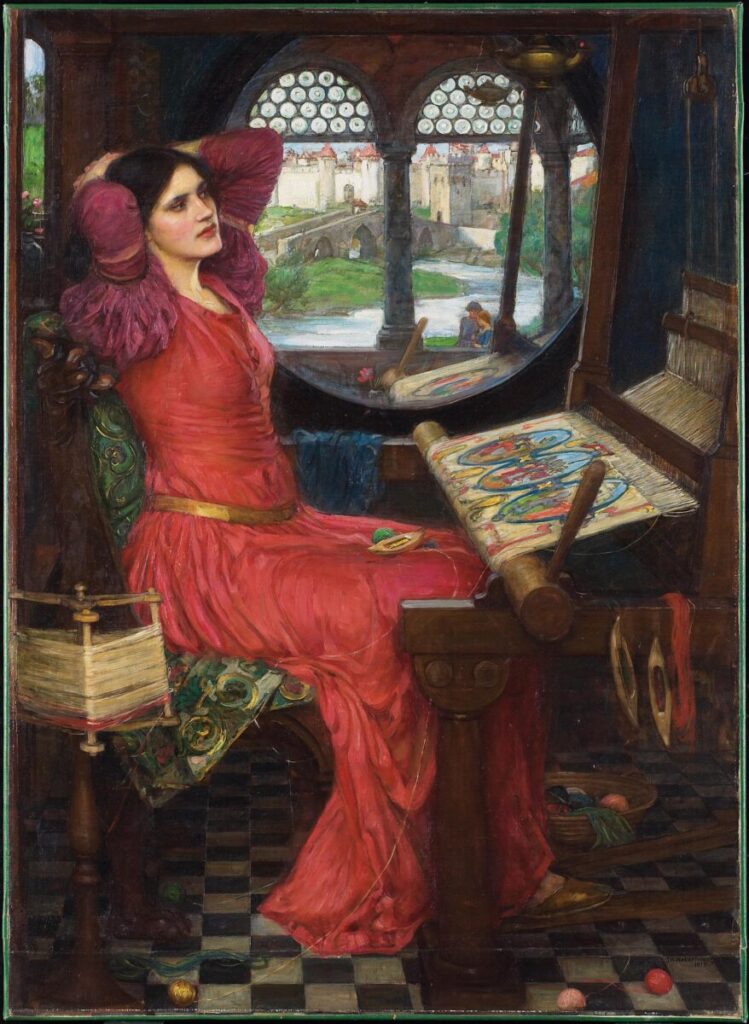
“I am half sick of shadows,” said the Lady of Shalott”
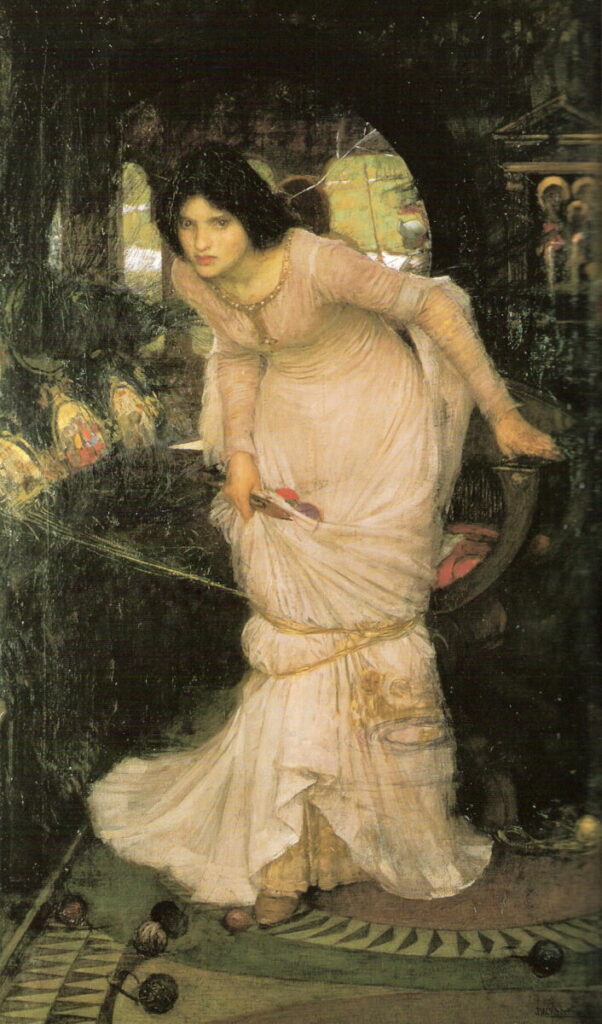
“The mirror crack’d from side to side; ‘The curse is come upon me,’ cried The Lady of Shalott”
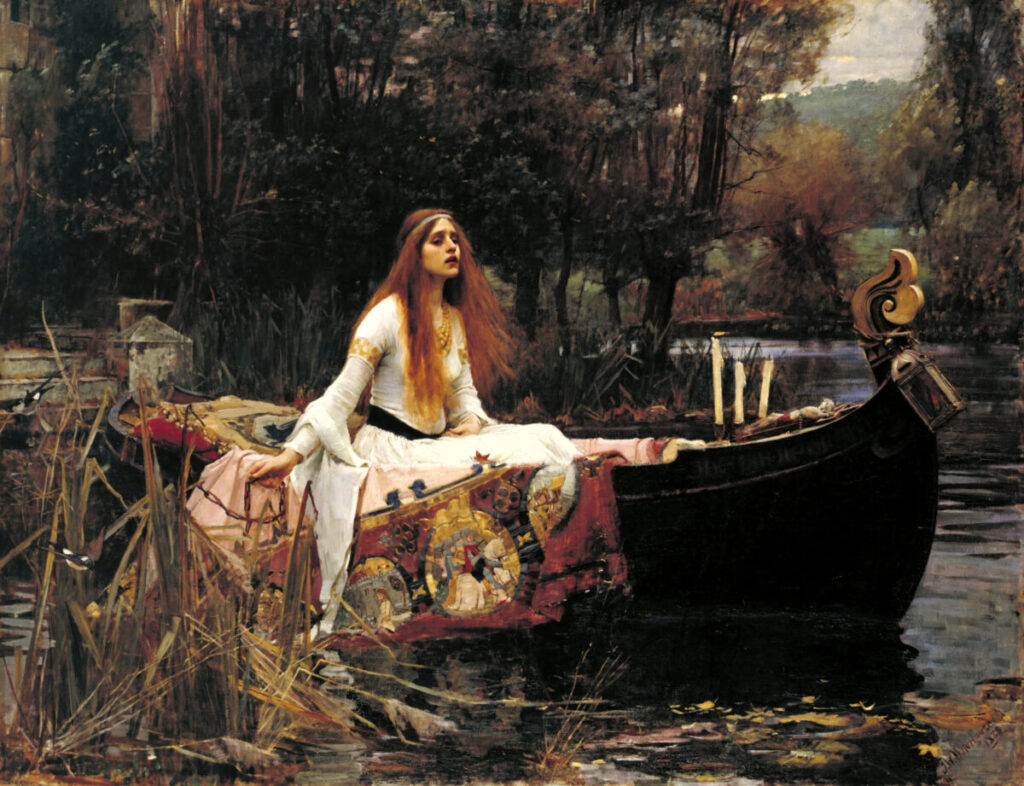
”It was the closing of the day: She loos’d the chain, and down she lay; The broad stream bore her far away, The Lady of Shalott”
翻訳、翻案~坪内逍遥翻訳『シャロットの妖姫』、夏目漱石『薤露行(カイロコウ)』など
日本では坪内逍遥が『シャロットの妖姫』という題名で訳しています。また、夏目漱石はこの詩と他に伝えられた騎士ランスロットにまつわる伝説を題材にして、小説『薤露行(カイロコウ)』を書き上げています。
詩は何度か改編されています。初稿の1833年版と最終の1842 年版があり、ともに愛好されています。
https://d.lib.rochester.edu/camelot/text/tennyson-shalott-comparison.html
eureka0313さんによる1842年版の翻訳もあります。(2025年12月25日閲覧)
https://www.eureka0313.com/entry/The_Lady_of_Shalott
以下は1833年版の翻訳(Google翻訳)と原文です。
1833年版

第一部

川の両岸には
大麦とライ麦の長い畑が広がり、
大地を覆い、空へと続いています。
そして、その畑を抜けて道が走り、
多くの塔を擁するキャメロットへと続いています。
黄色い葉のスイレン、
緑の葉をまとったラッパズイセン、
冷たい水面に震え、
シャロットの周囲を。

柳は白くなり、ポプラは震え、
陽光が降り注ぎ、
川の中の島のそばを、
キャメロットへと流れ落ちる流れの中で、
絶えず流れています。
四つの灰色の壁と四つの灰色の塔が、
花の咲く空間を見下ろし、
静かな島が
シャロットの貴婦人を包み込んでいます。

ひげを生やした大麦の下で、
朝も夜も刈り取る刈り手は、
彼女がいつも楽しそうに歌っているのを聞く。
まるで天使のように、
キャメロットの川辺で、
麦束を風通しの良い畝に積み上げながら、
月明かりの下で、疲れ果てた刈り手は
耳を澄ませながら囁く。「妖精の…シャロットの貴婦人よ。」

小さな島は
バラの柵で縁取られ、
バラの花が
縁取られている。誰も挨拶しない岸辺を、
小舟が絹の帆を揚げ、
キャメロットへと滑るように流れていく。
真珠の花輪が彼女の頭を飾り、
ベルベットのベッドに寄りかかり、
王室の衣装をまとって
シャロットの貴婦人。

第二部。

彼女には遊ぶ暇などなく、
彼女はいつも魔法の網を織り続けている。彼女が夜も昼も織物を止め、キャメロットを見下ろし続けるなら、呪いが降りかかる。
彼女はその呪いが何なのか知らない。
だからこそ彼女は着実に織り続け、
他に何も心配することはない。
シャロットの貴婦人よ。

彼女は喜びも恐れもほとんど感じずに暮らしている。
水面を近くを流れ、
羊の鈴が彼女の耳元でチリンチリンと鳴る。
彼女の前には鏡がくっきりとかかっており、
そびえ立つキャメロットを映している。
そして、迷路のような織物が渦巻く中、
彼女は不機嫌な村人たちや、
市場の娘たちの赤い外套が、
シャロットから通り過ぎていくのを見る。

時には喜びに満ちた乙女たちの一団、
のんびり歩く馬車に乗った修道院長、
時には巻き毛の羊飼いの少年、
あるいは深紅の衣をまとった長髪の従者たちが、
そびえ立つキャメロットへと通り過ぎていく。そして時折、青い鏡の間から
騎士たちが二頭ずつ馬でやって来る。
彼女には忠実で真実の騎士はいない。
シャロットの貴婦人。

しかし、彼女は今もなお、鏡の魔法の光景を織りなすことを楽しんでいる。
静かな夜にはしばしば
キャメロットから、羽飾りと灯り、そして音楽の葬儀がやってくる。
あるいは、月が頭上にある時には、
結婚したばかりの若い恋人たちがやってくる。
「影にはもううんざり」と
シャロットの貴婦人は言った。

第三部。

彼女の庇から弓矢が放たれた。
彼は麦の束の間を馬で進んだ。
太陽は葉の間からまばゆい光を放ち、
勇敢なサー・ランスロットの真鍮のすね当てに燃え上がった。
赤十字の騎士は永遠に跪き、
盾を携えた貴婦人に
盾は黄色の野原にきらめき、
遠くシャロットのほとりで

宝石の手綱は自由にきらめき、
黄金の銀河に垂れ下がる星々のように
きらめいた。
手綱の鈴は楽しそうに鳴り響いた。
彼がキャメロットから馬で下る時、
そして、紋章入りのバルドリックには
力強い銀のラッパが下げられ、
彼が馬で下る時、彼の鎧は鳴り響いた。
遠くシャロットのほとりで。

雲ひとつない青空の下、
鞍の革は宝石で覆われて輝いていた。
兜と兜の羽根は
燃え盛る一つの炎のように
燃えていた。
彼がキャメロットから馬で下る時、紫の夜空に幾度となく、
輝く星団の下、
髭を生やした流星が、光を引きながら、
緑のシャロットの上を移動する。

彼の広く澄んだ額は陽光に照らされて輝いていた。
磨かれた蹄で、彼の軍馬は闊歩した。
兜の下からは、
真っ黒な巻き毛が流れ落ち、
キャメロットから馬で下って来るにつれて、
彼は馬を走らせていた。
岸辺から、そして川から、
彼は水晶の鏡に映った。
「ティラ・リラ、ティラ・リラ」
サー・ランスロットは歌った。

彼女は織機を離れ、
部屋の中を三歩進んだ。
彼女は水草が咲くのを見た。
彼女は兜と羽根飾りを見た。
彼女はキャメロットを見下ろした。蜘蛛の巣が飛び出し、大きく漂い、
鏡は左右にひび割れ、
「呪いが私に降りかかった」と
シャロットの貴婦人は叫んだ。

第四部

嵐の東風が吹き荒れる中、
淡黄色の森は衰え、
岸辺の広い小川は嘆き、
低い空は激しく雨を降らせ、
キャメロットの上にそびえ立つ。
島の外には浅瀬の小舟が
柳の下に浮かんでいた。
彫刻された船尾の下に、彼女はこう書いた。
シャロットの貴婦人。

彼女は雲のように白い真珠の冠をかぶっていた。
雪のように白い衣をまとい、
それは悠々と舞い、(彼女の視界には、
まばゆいばかりの輝きを放つダイヤモンドが一つ留められていた。)
彼女の大きな目はキャメロットに釘付けだった。
激しい東風が強く吹き荒れても、
静かに腕を組んで、
水辺には女王のような
シャロットの貴婦人が立っていた。

揺るぎない、石のような視線で――
まるで恍惚とした、勇敢な予言者のように、
自らの不運を見つめ、
沈黙し、生気のない顔で――
彼女はキャメロットを見下ろした。
日が暮れようとしていた。
彼女は鎖を解き、横たわった。
広い流れが彼女を遠くへ運んでいった。
シャロットの貴婦人。

まるで船乗りたちが
故郷から遠く離れた小川や排水路を漂流する時のように、

泡とともに上下し、死にゆく白鳥の荒々しいさえずりが岸へと吹き寄せられる。
キャメロットへも

船着き場が柳の茂る丘陵地帯や野原を縫うように静かに進むにつれ、

彼らは彼女が死の歌を詠むのを聞いた。
シャロットの貴婦人。

長く引き延ばされた、悲しげで神聖なキャロル。
彼女は高らかに、低く詠唱し続けた。
目が完全に暗くなるまで。
滑らかな顔がゆっくりと鋭くなった。
塔のそびえるキャメロットへと向き直った。
潮に乗ろうとする間もなく、
水辺の最初の家で、
歌を歌いながら彼女は死んだ。
シャロットの貴婦人。

塔とバルコニーの下、
庭の壁と回廊を通り過ぎ、
青白い、青白い死体が、
高い家々の間を冷たく漂い、
塔のそびえるキャメロットへと死んでいった。
騎士と市民、領主と貴婦人が、
板張りの埠頭へとやって来た。
船尾の下で、彼らは彼女の名前を読んだ。
「シャロットの貴婦人」。

彼らは十字を切り、それぞれの星に祝福を捧げた。
騎士、吟遊詩人、修道院長、地主、客。彼女の胸には羊皮紙が敷かれていた。
それは何よりも、
キャメロットの博識な者たちを困惑させた。
「網は奇妙に織り込まれていた。
魔法は完全に解けた。
近づいて、恐れるな。これが私だ。
シャロットの貴婦人。
1833 edition

Part the First.

On either side the river lie
Long fields of barley and of rye,
That clothe the wold and meet the sky.
And thro' the field the road runs by
 To manytowered Camelot.
The yellowleavèd waterlily,
The greensheathèd daffodilly,
Tremble in the water chilly,
 Round about Shalott.

Willows whiten, aspens shiver,
The sunbeam-showers break and quiver
In the stream that runneth ever
By the island in the river,
 Flowing down to Camelot.
Four gray walls and four gray towers
Overlook a space of flowers,
And the silent isle imbowers
 The Lady of Shalott.

Underneath the bearded barley,
The reaper, reaping late and early,
Hears her ever chanting cheerly,
Like an angel, singing clearly,
 O'er the stream of Camelot.
Piling the sheaves in furrows airy,
Beneath the moon, the reaper weary
Listening whispers, "'tis the fairy
 Lady of Shalott."

The little isle is all inrailed
With a rose-fence, and overtrailed
With roses: by the marge unhailed
The shallop flitteth silkensailed,
 Skimming down to Camelot.
A pearlgarland winds her head:
She leaneth on a velvet bed,
Full royally apparellèd
 The Lady of Shalott.

Part the Second.

No time hath she to sport and play:
A charmèd web she weaves alway.
A curse is on her, if she stay
Her weaving, either night or day,
 To look down to Camelot.
She knows not what the curse may be;
Therefore she weaveth steadily,
Therefore no other care hath she,
 The Lady of Shalott.

She lives with little joy or fear.
Over the water, running near,
The sheepbell tinkles in her ear.
Before her hangs a mirror clear,
 Reflecting towered Camelot.
And, as the mazy web she whirls,
She sees the surly village-churls,
And the red cloaks of market-girls,
 Pass onward from Shalott.

Sometimes a troop of damsels glad,
An abbot on an ambling pad,
Sometimes a curly shepherd lad,
Or longhaired page, in crimson clad,
 Goes by to towered Camelot.
And sometimes thro' the mirror blue,
The knights come riding, two and two.
She hath no loyal knight and true
 The Lady of Shalott.

But in her web she still delights
To weave the mirror's magic sights:
For often thro' the silent nights
A funeral, with plumes and lights
 And music, came from Camelot.
Or, when the moon was overhead,
Came two young lovers, lately wed:
"I am half-sick of shadows," said
 The Lady of Shalott.

Part the Third.

A bowshot from her bower-eaves.
He rode between the barleysheaves:
The sun came dazzling thro' the leaves,
And flamed upon the brazen greaves
 Of bold Sir Launcelot.
A redcross knight for ever kneeled
To a lady in his shield,
That sparkled on the yellow field,
 Beside remote Shalott.

The gemmy bridle glittered free,
Like to some branch of stars we see
Hung in the golden galaxy.
The bridle-bells rang merrily,
 As he rode down from Camelot.
And, from his blazoned baldric slung,
A mighty silver bugle hung,
And, as he rode, his armour rung,
 Beside remote Shalott.

All in the blue unclouded weather,
Thickjewelled shone the saddle-leather.
The helmet, and the helmet-feather
Burned like one burning flame together,
 As he rode down from Camelot.
As often thro' the purple night,
Below the starry clusters bright,
Some bearded meteor, trailing light,
 Moves over green Shalott.

His broad clear brow in sunlight glowed.
On burnished hooves his warhorse trode.
From underneath his helmet flowed
His coalblack curls, as on he rode,
 As he rode down from Camelot.
From the bank, and from the river,
He flashed into the crystal mirror,
"Tirra lirra, tirra lirra,"
 Sang Sir Launcelot.

She left the web: she left the loom:
She made three paces thro' the room:
She saw the waterflower bloom:
She saw the helmet and the plume:
 She looked down to Camelot.
Out flew the web, and floated wide,
The mirror cracked from side to side,
'The curse is come upon me," cried
 The Lady of Shalott.

Part the Fourth.

In the stormy eastwind straining
The pale-yellow woods were waning,
The broad stream in his banks complaining,
Heavily the low sky raining
 Over towered Camelot:
Outside the isle a shallow boat
Beneath a willow lay afloat,
Below the carven stern she wrote,
 THE LADY OF SHALOTT.

A cloudwhite crown of pearl she dight.
All raimented in snowy white
That loosely flew, (her zone in sight,
Clasped with one blinding diamond bright,)
 Her wide eyes fixed on Camelot,
Though the squally eastwind keenly
Blew, with folded arms serenely
By the water stood the queenly
 Lady of Shalott.

With a steady, stony glance—
Like some bold seer in a trance,
Beholding all his own mischance,
Mute, with a glassy countenance—
 She looked down to Camelot.
It was the closing of the day,
She loosed the chain, and down she lay,
The broad stream bore her far away,
 The Lady of Shalott.

As when to sailors while they roam,
By creeks and outfalls far from home,
Rising and dropping with the foam,
From dying swans wild warblings come,
 Blown shoreward; so to Camelot
Still as the boathead wound along
The willowy hills and fields among,
They heard her chanting her deathsong,
 The Lady of Shalott.

A longdrawn carol, mournful, holy,
She chanted loudly, chanted lowly,
Till her eyes were darkened wholly,
And her smooth face sharpened slowly
 Turned to towered Camelot:
For ere she reached upon the tide
The first house by the waterside,
Singing in her song she died,
 The Lady of Shalott.

Under tower and balcony,
By gardenwall and gallery,
A pale, pale corpse she floated by,
Deadcold, between the houses high,
 Dead into towered Camelot.
Knight and burgher, lord and dame,
To the plankèd wharfage came:
Below the stern they read her name,
 "The Lady of Shalott."

They crossed themselves, their stars they blest,
Knight, minstrel, abbot, squire and guest.
There lay a parchment on her breast,
That puzzled more than all the rest,
 The wellfed wits at Camelot.
"The web was woven curiously
 The charm is broken utterly,
 Draw near and fear not – this is I,
 The Lady of Shalott.
(註:詩中にあるキャメロット(Camelot)とは伝説で語られるアーサー王が築いた城です。ランスロットはアーサー王を支える円卓の騎士のひとり。類なき勇者です。